How Much Fibre Do You Need Per Day? Canadian Targets and Easy Food Swaps
How much fibre per day? Health Canada says 25 g for women and 38 g for men, but most Canadians get about half. Here are the foods that close the gap.
The short answer
- Health Canada says adult women need about 25 g of fibre a day and men about 38 g. After 50, the targets drop to 21 g and 30 g.
- Most Canadians get only about half of that. The WHO recommends adults eat at least 25 g of naturally occurring fibre a day.
- Beans, lentils, whole grains, fruit with the skin on, nuts and seeds close the gap. Add fibre slowly and drink more water as you go.
Fibre rarely gets the attention protein does, but it's one of the nutrients Canadians fall shortest on. The good news is that the fix is mostly ordinary food: a few swaps at breakfast and a scoop of beans or lentils a day will get most people close to their target.
How much fibre you need per day
Health Canada's short answer: women need 25 grams of fibre per day and men need 38 grams (Health Canada). Those figures come from the Dietary Reference Intakes, which set an Adequate Intake for total fibre that changes a little with age and life stage (Health Canada DRI tables).
| Age / life stage | Women (g/day) | Men (g/day) |
|---|---|---|
| 14–18 | 26 | 38 |
| 19–50 | 25 | 38 |
| 51 and older | 21 | 30 |
| Pregnancy | 28 | — |
| Breastfeeding | 29 | — |
The World Health Organization lands in the same place. Its 2023 guideline recommends that adults eat at least 25 g of naturally occurring dietary fibre and at least 400 g of vegetables and fruit a day (WHO, 2023).
Why fibre is worth tracking
Fibre is a carbohydrate your body can't digest, found in plant foods (Health Canada). Because it isn't absorbed like other carbs, it provides about 2 calories per gram rather than 4 (CFIA), and it adds bulk that helps meals feel more filling, which is useful when you're eating in a calorie deficit.
The longer-term evidence is strong. A large series of reviews commissioned for the WHO and published in The Lancet pooled 185 observational studies and 58 clinical trials (Reynolds et al., 2019). People with the highest fibre intakes had a 15–30% lower risk of dying from any cause and from cardiovascular disease than those with the lowest, and 16–24% lower rates of coronary heart disease, stroke, type 2 diabetes and colorectal cancer. The benefits showed up at 25–29 g a day or more, and the authors noted higher intakes might offer even more protection.
High-fibre foods: how much is in a serving
Here's how common foods compare, using serving sizes from HealthLinkBC's fibre guide (HealthLinkBC). Packaged foods vary by brand, so check the label for cereals and bread.
Grams of fibre per serving
Legumes stand out because they bring protein along with the fibre. That makes them an easy win if you're also trying to hit a protein target.
What a 25 g and a 38 g day look like
You don't need special products. This sample day uses only the foods above and reaches about 38 g. Skip the afternoon snack and use one slice of bread at lunch, and you're still around 27 g, above the 25 g target.
| Meal | Foods | Fibre |
|---|---|---|
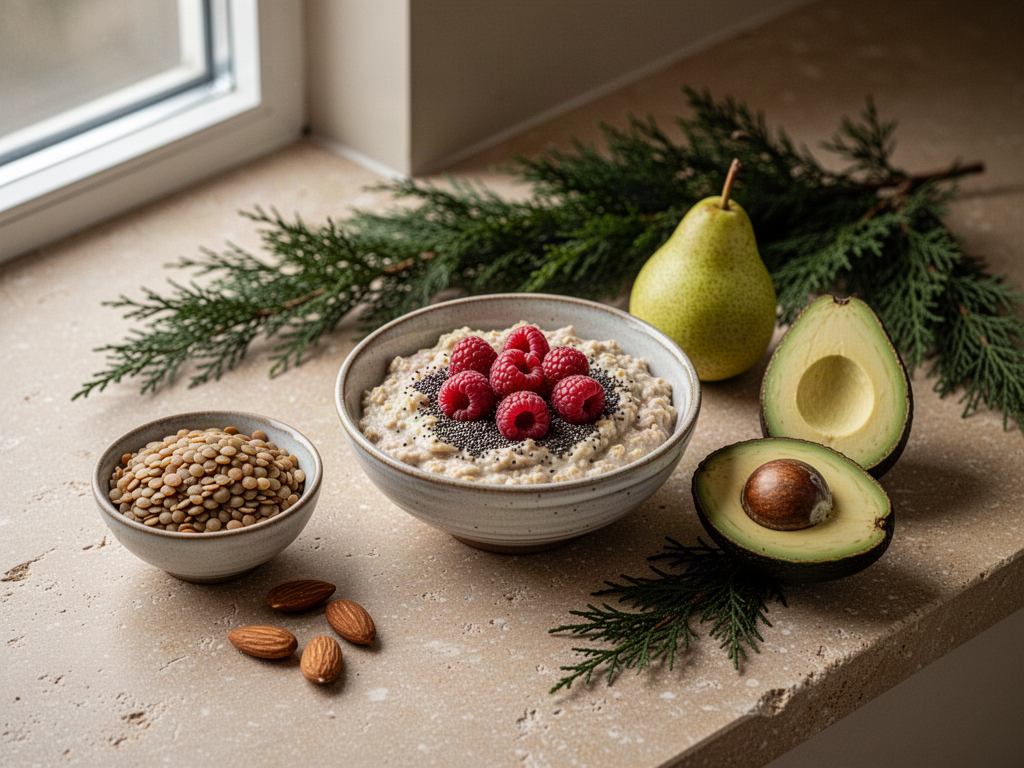
| Breakfast | Oatmeal (¾ cup) with ½ cup raspberries and 1 tbsp chia seeds | 11.0 g |
| Lunch | Sandwich on 2 slices whole wheat bread, plus an apple | 7.7 g |
| Snack | ¼ cup almonds and a pear | 9.1 g |
| Dinner | ¾ cup lentils, ½ cup quinoa and ½ cup cooked broccoli or carrots | 10.4 g |
| Total | 38.2 g |
How to read fibre on a Canadian label
On a Canadian Nutrition Facts table, fibre is listed under carbohydrate, and its % Daily Value is based on 28 g for adults and children 4 and older (Health Canada, Table of Daily Values). Health Canada's quick rule applies: 5% DV or less is a little, 15% DV or more is a lot (the same rule helps you spot how much sodium is in a food and how much sugar is too much). Our guide to counting macros explains the rest of the table.
Front-of-package fibre claims also have legal minimums per serving (Health Canada):
| Claim on the package | Minimum fibre per serving |
|---|---|
| "Source of fibre" | 2 g |
| "High source of fibre" / "High in fibre" | 4 g |
| "Very high source of fibre" / "Excellent source" | 6 g |
How to eat more fibre without the bloating
Five easy upgrades
- 1
Go slowly
Add fibre gradually over a few weeks. HealthLinkBC notes that adding it slowly helps limit gas, cramping and discomfort.
- 2
Drink more fluids
More fibre works best with more water, which helps keep things moving comfortably. Not sure how much is enough? See how much water to drink a day.
- 3
Fix breakfast first
Swap a refined cereal for oats or a bran cereal and add berries or chia. That one meal can supply 10 g or more.
- 4
Add a legume a day
Toss chickpeas into a salad, lentils into a pasta sauce, or beans into chili or a burrito bowl.
- 5
Keep the skins on
Eat apples, pears and potatoes with the skin, and choose whole fruit over juice.
Frequently asked questions
How much fibre should a woman eat per day?
Health Canada recommends about 25 g a day for women aged 19 to 50 and 21 g from age 51. Needs rise to 28 g during pregnancy and 29 g while breastfeeding.
How much fibre should a man eat per day?
About 38 g a day for men aged 14 to 50, and 30 g from age 51, according to Health Canada's Dietary Reference Intakes.
Can you eat too much fibre?
Health Canada hasn't set an upper limit for fibre. Jumping up quickly can cause gas and bloating, so increase it gradually and drink more fluids. If you have a digestive condition, check with your health care provider.
Are fibre supplements as good as food?
The strongest evidence for fibre's health benefits comes from naturally occurring fibre in foods like whole grains, legumes, vegetables and fruit, which also bring vitamins, minerals and protein. Food first is the safer default.
Sources
- Health Canada (2025). Fibre
- Health Canada. Dietary Reference Intakes tables: Reference values for macronutrients
- Health Canada. Nutrition labelling: Table of Daily Values
- Health Canada. Nutrient content claims: what they mean
- Canadian Food Inspection Agency. Elements within the Nutrition Facts table (energy value of dietary fibre)
- World Health Organization (2023). WHO updates guidelines on fats and carbohydrates
- Reynolds A. et al. (2019). Carbohydrate quality and human health: a series of systematic reviews and meta-analyses. The Lancet (summary via ScienceDaily)
- HealthLinkBC (2021). File #68h: Food Sources of Fibre
This article is general information, not medical advice. If you have a health condition, are pregnant, or take medication, talk to your doctor or a registered dietitian before changing how you eat or train.