How Much Sugar Per Day? Daily Limits and How to Read Canadian Labels
How much sugar per day? WHO advises under 10% of calories from free sugars, ideally about 25 g. Plus how to read Canadian labels and the High in symbol.
The short answer
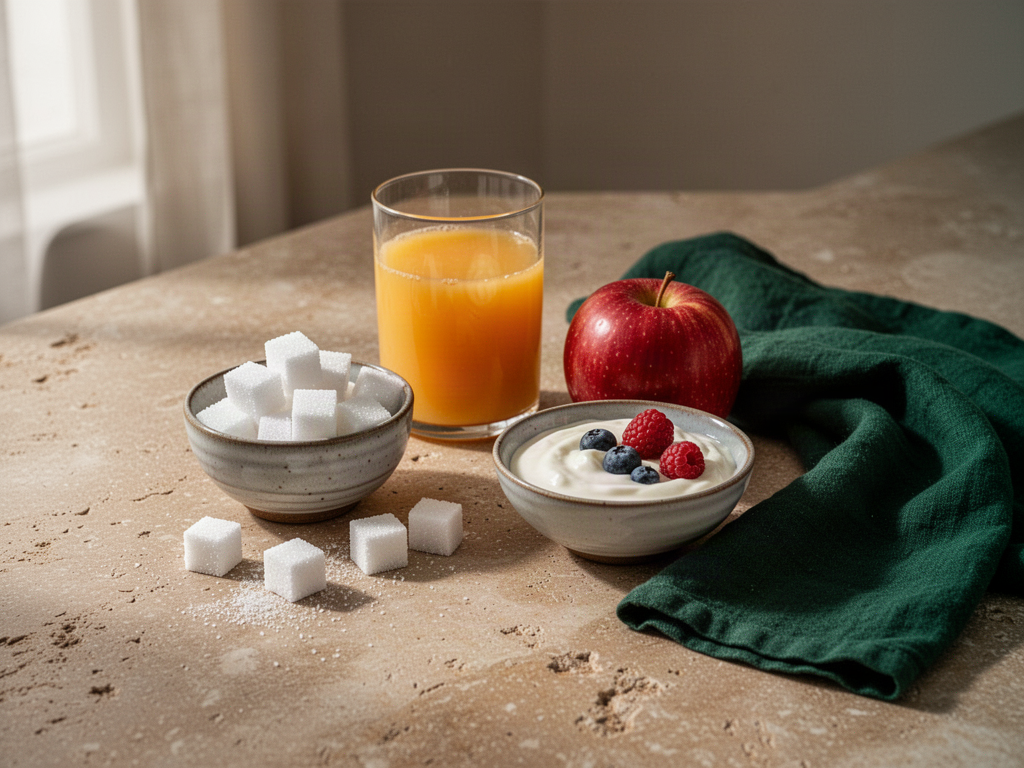
- The WHO recommends keeping free sugars under 10% of your calories, and suggests going below 5% (about 25 g, or 6 teaspoons, a day) for extra benefit.
- The UK's NHS sets a simple adult cap of 30 g of free sugars a day. Sugars that come naturally in whole fruit, vegetables and plain milk don't count toward these limits.
- On Canadian labels, the % Daily Value for sugars is based on 100 g of total sugars. 15% DV or more is a lot, and most packaged foods at that level now carry a "High in sugars" symbol.
Sugar advice can feel contradictory: one source says 25 g, another says 30 g, and the Canadian label uses 100 g. They're not actually disagreeing. They measure different things, and once you know which sugars count, the numbers line up. Here's what each limit means and how to use the labels on Canadian groceries to stay within it.
How much sugar per day: the short answer
The World Health Organization's guideline is the one most others build on. It strongly recommends that adults and children keep free sugars to less than 10% of total energy intake, and suggests a further cut to below 5%, or roughly 25 grams (6 teaspoons) a day, for additional benefits (WHO). The 5% target is a *conditional* recommendation because it rests on fewer studies, mainly on tooth decay (WHO guideline).
Because the WHO's 5% works out to about 25 g, its 10% upper limit is roughly 50 g of free sugars a day for a typical adult. Eat more or fewer calories than average and the gram figure scales with you.
The NHS turns the stricter target into one easy number: adults should have no more than 30 g of free sugars a day, roughly 7 sugar cubes (NHS).
Daily sugar numbers compared (grams)
Free sugars, added sugars and total sugars
The confusion mostly comes from three overlapping terms:
- Free sugars (WHO and NHS term): sugars added to foods and drinks by the manufacturer, cook or you, plus sugars naturally present in honey, syrups, fruit juices and fruit juice concentrates (WHO).
- Added sugars: the sugar-based ingredients put into a food. Juice is the main difference: unsweetened 100% juice has no added sugar but still counts as free sugars.
- Total sugars (the Canadian Nutrition Facts table): every sugar in the food, including those naturally found in fruit, vegetables and milk (Health Canada).
The WHO limits don't apply to sugars in fresh fruit and vegetables or sugars naturally in milk, because there's no reported evidence of harm from them (WHO). Health Canada makes the same point from the other direction: it recommends an eating pattern where most sugars come from fruits, vegetables and unsweetened dairy like plain milk and yogurt, since those foods also bring fibre, vitamins and potassium (Health Canada).
Why the limit matters
The WHO based its 10% recommendation on evidence that adults who eat less sugar have lower body weight, that adding sugar to the diet is linked to weight gain, and that tooth decay rates are higher above 10% (WHO). Health Canada links too many added sugars with tooth decay in children and excess calories, which can lead to weight gain and raise the risk of chronic diseases such as type 2 diabetes and heart disease (Health Canada).
In practice, sugar is mostly a calorie-budget question. Sugary drinks and sweets add calories without much protein or fibre to keep you full, which makes a steady calorie deficit harder to hold. That doesn't make any single treat a problem; it's the daily pattern that counts.
Where the sugar actually comes from
Health Canada lists the biggest sources as fruit juice, sugary drinks, chocolate and candy, baked goods (cakes, donuts, cookies, pastries, granola bars), ice cream and frozen desserts, and honey and syrups like maple syrup (Health Canada). The WHO adds that much of it is hidden in foods we don't think of as sweet: 1 tablespoon of ketchup has about 4 g of free sugars, and one can of sugary soda can have up to 40 g, more than the WHO's 5% target on its own (WHO).
Drinks are the easiest place to cut. Water, plain milk and unsweetened coffee or tea cover most needs; here's how much water you actually need. If your daily coffee comes with sugar, our Tim Hortons high-protein guide has lower-sugar orders.
How to read sugar on a Canadian label
Canadian packaging gives you three tools, and together they answer both "how much sugar?" and "is it added?" (For the rest of the panel, see our step-by-step guide on how to read a nutrition label in Canada.)
1. Nutrition Facts table: grams and % DV
Sugars are listed under carbohydrate in grams per serving, with a % Daily Value. For adults and children 4 and older, that % DV is based on 100 g of total sugars (50 g for foods made only for children aged 1 to 4) (Health Canada, Table of Daily Values). Health Canada's quick rule: 5% DV or less is a little sugar, 15% DV or more is a lot (Health Canada). The same 5/15 rule works for sodium and fibre, and our macro-counting guide explains the rest of the table.
Remember that the 100 g covers *total* sugars. A plain yogurt and a sweetened one can both show sugar, but only one has free sugars, which is where the ingredient list comes in.
2. Ingredient list: all sugars grouped together
Sugar-based ingredients are now grouped in brackets after the word "Sugars", listed in order of weight, for example *Sugars (fancy molasses, brown sugar, sugar)*. Ingredients are listed from most to least by weight, so if "Sugars" comes first, there's more sugar in the food than anything else (Health Canada). No "Sugars" group usually means the sugar on the table is natural, as in plain milk or unsweetened yogurt.
3. Front-of-package "High in sugars" symbol
Since the transition period ended on December 31, 2025, most prepackaged foods that meet Health Canada's thresholds must show a black-and-white magnifying-glass symbol saying "High in" sugars, sodium and/or saturated fat (Health Canada).
| Type of food | Symbol required at | Sugars per serving or reference amount |
|---|---|---|
| Most prepackaged foods | 15% DV | 15 g |
| Small reference amounts, 30 g or 30 mL or less (sauces, dressings, crackers) | 10% DV | 10 g |
| Main dishes, 200 g or more (pizza, mac and cheese, burritos) | 30% DV | 30 g |
Some foods are exempt even when they contain sugar: fresh, frozen, canned or dried fruits and vegetables; 2% and whole milk; most yogurts and cheeses (for sugars and saturated fat, because they're key calcium sources); and packages of sugar, honey or maple syrup, where the symbol would be redundant (Health Canada). So no symbol doesn't always mean low sugar: still glance at the table.
Easy ways to cut back
Five swaps that add up
- 1
Start with drinks
Swap pop and sweetened drinks for water, sparkling water or plain milk. A single can of soda can use up more than a day's 25 g target.
- 2
Keep juice small
Choose whole fruit over juice, and keep juice and smoothies to about 150 mL a day.
- 3
Buy plain, add your own
Plain yogurt, oats and unsweetened cereals let you control the sweetness with fruit instead of syrups.
- 4
Use the 5/15 rule
When comparing two products, pick the one with the lower % DV for sugars, and check whether "Sugars" appears near the start of the ingredient list.
- 5
Taper, don't quit
Cut the sugar in coffee or tea gradually. Small, steady changes are easier to keep than a strict ban.
Frequently asked questions
How many grams of sugar should I have a day?
The WHO recommends keeping free sugars below 10% of your calories, which is roughly 50 g for a typical adult, and suggests aiming below 5%, about 25 g (6 teaspoons). The NHS sets a 30 g daily cap for adults. These limits are for free sugars, not the sugar in whole fruit, vegetables or plain milk.
Does the sugar in fruit count?
Not toward the WHO or NHS limits. Sugars naturally in whole fresh fruit, vegetables and milk aren't counted as free sugars. Fruit juice and smoothies are different: their sugars are released and count, so keep them to about 150 mL a day.
Is 100 g of sugar a day OK?
The 100 g on Canadian labels is the Daily Value used to calculate % DV for total sugars, including natural sugars in fruit and milk. It's a reference for comparing foods, not a target for added sugar. Free sugars are best kept well below that, ideally under 25 to 50 g.
What does "High in sugars" mean on Canadian food?
It means one serving (or the reference amount, if larger) contains at least 15% of the Daily Value for sugars, which is 15 g for most foods. The threshold is 10% for small items like sauces and 30% for main dishes of 200 g or more.
Sources
- World Health Organization (2015). WHO calls on countries to reduce sugars intake among adults and children
- World Health Organization (2015). Guideline: Sugars intake for adults and children (NCBI Bookshelf)
- NHS. Sugar: the facts
- Health Canada. Sugars: Sugars and your health
- Health Canada. Sugars: Using the food labels
- Health Canada. Nutrition labelling: Table of daily values
- Health Canada. Summary of amendments: Nutrition symbols (front-of-package labelling)
This article is general information, not medical advice. If you have a health condition, are pregnant, or take medication, talk to your doctor or a registered dietitian before changing how you eat or train.