How Much Protein Do You Need to Build Muscle? (With a Simple Chart)
Most lifters do best with about 1.6 g of protein per kg of body weight a day (up to 2.2 g/kg). See the research, a chart by body weight and easy ways to hit it.
The short answer
- For building muscle, research points to about 1.6 g of protein per kg of body weight per day, with up to 2.2 g/kg as a safe upper target for people who want to cover every base.
- That's double the basic RDA of 0.8 g/kg, which is set to prevent deficiency, not to maximise muscle.
- Split it across 3–5 meals of roughly 20–40 g each, and pair it with regular strength training. Protein without training doesn't build muscle.
Protein is the building material for muscle, but more isn't always better. The good news: the research here is unusually clear, and the target is easier to hit than most supplement ads suggest.
What the research actually says
Health Canada's recommended dietary allowance for adults is 0.8 g of protein per kg of body weight per day (Health Canada). That number is designed to cover the basic needs of almost everyone. It was never meant as a target for people trying to build muscle.
For people who train, the International Society of Sports Nutrition says 1.4–2.0 g/kg per day is enough for most exercising people to build and keep muscle (ISSN position stand, 2017). A large 2018 meta-analysis of 49 trials and 1,863 people found gains in lean mass levelled off at around 1.62 g/kg per day. Because people vary, the authors suggested ~2.2 g/kg as a sensible upper target for anyone who wants to be sure (Morton et al., BJSM).
Protein targets by body weight
| Body weight | 1.6 g/kg (most people) | 2.2 g/kg (upper target) | Per meal (4 meals) |
|---|---|---|---|
| 55 kg (121 lb) | 88 g | 121 g | 22–30 g |
| 65 kg (143 lb) | 104 g | 143 g | 26–36 g |
| 75 kg (165 lb) | 120 g | 165 g | 30–41 g |
| 85 kg (187 lb) | 136 g | 187 g | 34–47 g |
| 95 kg (209 lb) | 152 g | 209 g | 38–52 g |
| 105 kg (231 lb) | 168 g | 231 g | 42–58 g |
How to spread protein through the day
Your body can't store protein the way it stores carbs and fat, so how you split it matters a little. The ISSN suggests doses of about 0.25 g/kg (or 20–40 g) per meal, spread every 3–4 hours (ISSN). For most people that simply means a solid protein source at each meal, plus a snack if your target is high.
- Breakfast: eggs, Greek yogurt, cottage cheese or a protein latte instead of a plain coffee (here are the best high-protein Tim Hortons orders).
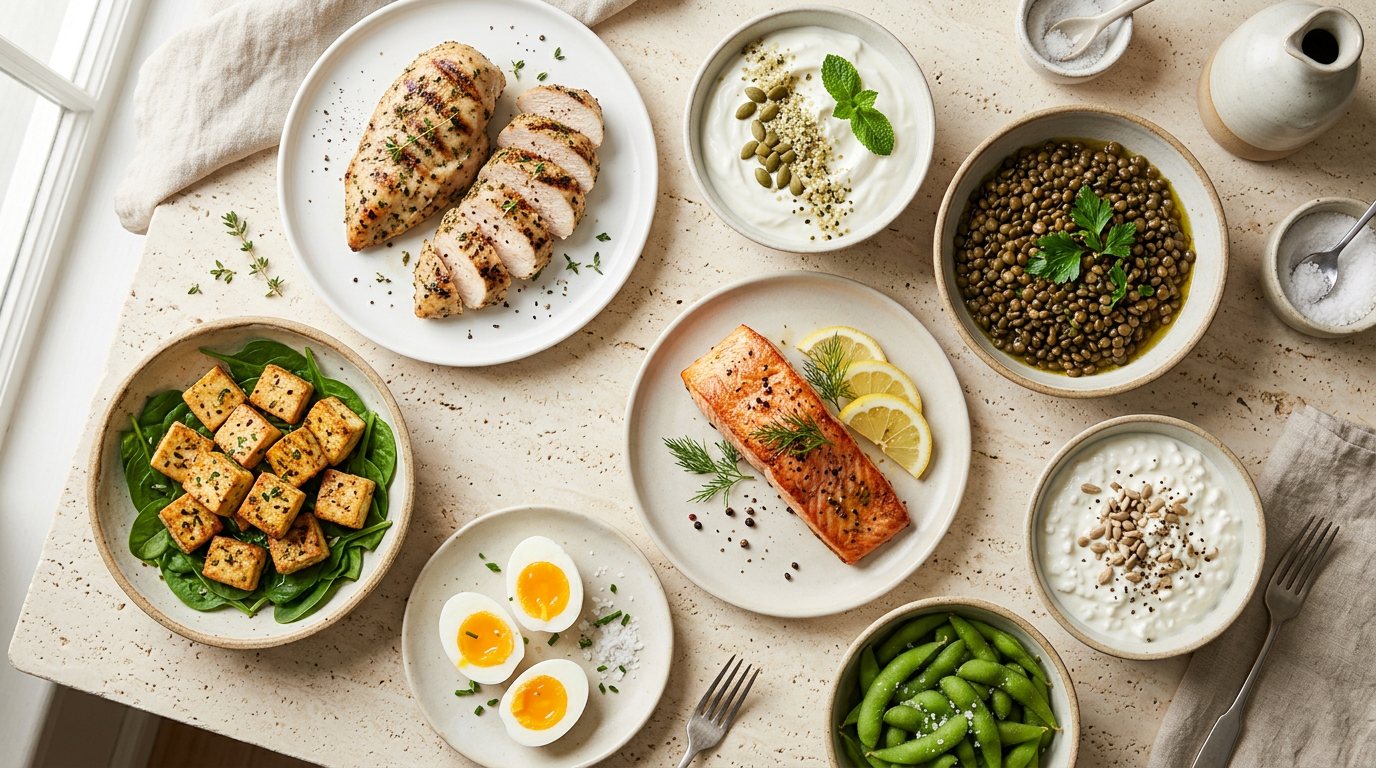
- Lunch and dinner: a palm-to-hand-sized portion of chicken, fish, tofu, lean beef or legumes.
- Snack: a cup of milk or soy milk, edamame, jerky, or a shake if you're short at the end of the day.
- Before bed (optional): 30–40 g of a slow-digesting protein like casein or cottage cheese can support overnight muscle building, according to the ISSN.
Easy high-protein foods (approximate values)
Protein per serving
Does it matter if protein comes from plants?
Animal proteins tend to be richer in leucine, the amino acid that switches on muscle building, which is why the ISSN mentions aiming for about 700–3,000 mg of leucine per serving. Plant eaters can still build muscle well: eat a variety of plant proteins (soy, lentils, beans, seitan, pea protein) and lean toward the higher end of your protein range.
Protein won't build muscle on its own
Protein supports muscle growth; training causes it. Canada's movement guidelines recommend muscle-strengthening activities at least twice a week (CSEP). The biggest driver of new muscle is doing a bit more over time: more weight, more reps or more sets. Our guide to progressive overload explains how. Curious about supplements beyond protein? Here's how much creatine to take and whether it works.
Frequently asked questions
Is 1 gram of protein per pound too much?
One gram per pound is about 2.2 g/kg. That's the upper target suggested by the 2018 meta-analysis, so it's not harmful for healthy people, but most lifters get the same muscle-building benefit at around 0.7 g per pound (1.6 g/kg).
Should I count protein based on my current weight or goal weight?
If you're lean to moderately lean, use your current weight. If you have a lot of weight to lose, using your goal weight gives a more realistic number.
Do I need protein powder?
No. Powders are just convenient food. If you can reach your target with meals, you don't need them. They're useful when you're busy or your target is high.
Is a high-protein diet safe for my kidneys?
For healthy adults, intakes in the 1.4–2.0 g/kg range are considered safe by the ISSN. If you have kidney disease or another medical condition, ask your doctor before increasing protein.
Sources
- Health Canada. Dietary Reference Intakes: reference values for macronutrients
- Jäger R. et al. (2017). International Society of Sports Nutrition Position Stand: protein and exercise. JISSN 14:20
- Morton R.W. et al. (2018). Protein supplementation and resistance-training gains: systematic review and meta-analysis. Br J Sports Med 52:376–384
- Canadian 24-Hour Movement Guidelines for Adults (CSEP)
- USDA FoodData Central (food composition data)
This article is general information, not medical advice. If you have a health condition, are pregnant, or take medication, talk to your doctor or a registered dietitian before changing how you eat or train.