RPE and RIR Explained: How Hard Should Your Sets Feel?
RPE and RIR rate how hard a lifting set was. Learn the 1–10 scale, how many reps in reserve to leave for muscle or strength, and how to get accurate at it.
The short answer
- RIR (reps in reserve) is how many more good reps you could have done when you stopped a set. RPE on the lifting scale is the same idea on a 1–10 scale: RPE 8 = 2 reps left, RPE 9 = 1, RPE 10 = none.
- For muscle growth, researchers suggest most sets of 6–12 reps at RPE 8–10 (0–2 RIR), with failure saved for the last set of simpler exercises. Strength gains look similar across a wide range of RIR.
- Most people misjudge by about 1 rep, usually guessing they have fewer left than they do. Accuracy improves closer to failure, with heavier loads, and in later sets.
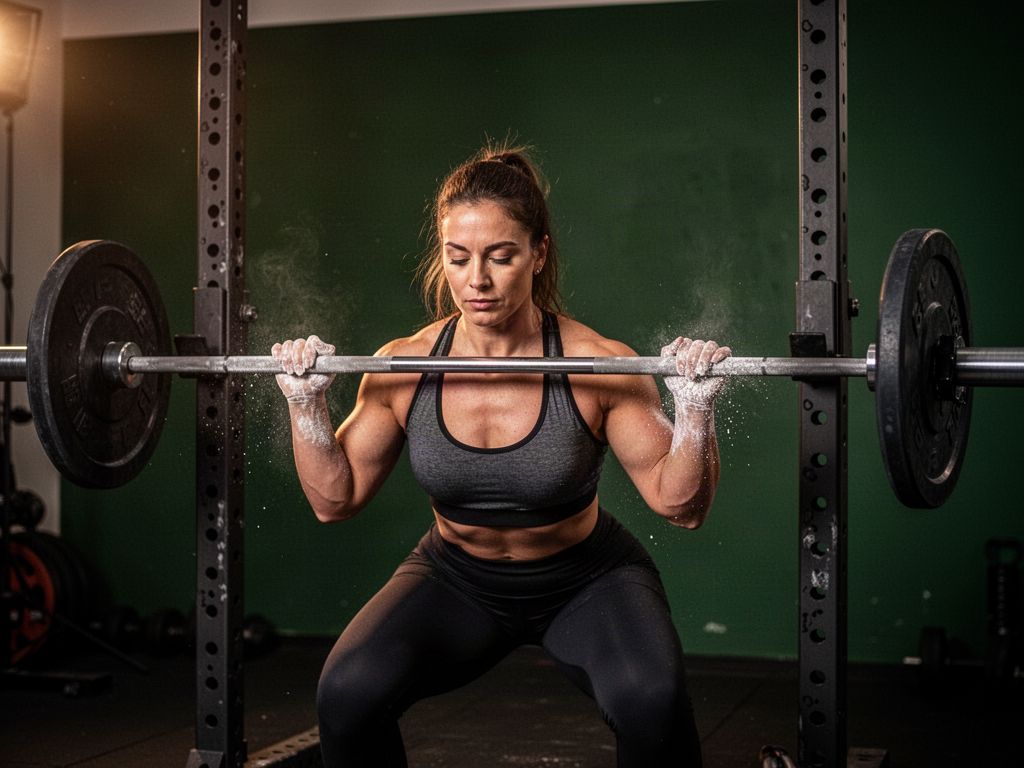
"Do 3 sets of 10, stopping two reps short of failure." Instructions like this are now common in training plans and apps, but they only work if you know what "two reps short" feels like. That's what RPE and RIR are for: a simple way to describe how hard a set was, so you can make every session hard enough to count without grinding yourself into the ground.
What RIR and RPE mean
RIR, or reps in reserve, is the number of extra good-form reps you believe you could have done when you racked the weight. Stop a set of squats feeling you had two more in you, and that set was 2 RIR.
RPE, or rating of perceived exertion, started as a 6–20 scale for cardio. For lifting, researchers built a 1–10 version where each number is tied to reps in reserve, so the two terms describe the same thing (Zourdos et al., 2016). A Strength and Conditioning Journal article by the same research group lays out the scale like this (Helms et al., 2016):
| RPE | What it means | Reps in reserve |
|---|---|---|
| 10 | Maximum effort | 0 |
| 9 | 1 rep remaining | 1 |
| 8 | 2 reps remaining | 2 |
| 7 | 3 reps remaining | 3 |
| 5–6 | 4–6 reps remaining | 4–6 |
| 3–4 | Light effort | — |
| 1–2 | Little to no effort | — |
Notice that the low end of the scale isn't described in reps. The authors explain that people are much better at judging reps in reserve close to failure, so below RPE 5 the scale switches to general descriptions of effort.
Why use RPE instead of fixed weights?
Classic programs prescribe a percentage of your one-rep max: "5 reps at 80%". The problem is that strength moves around from day to day with sleep, food and stress, and people can do very different numbers of reps at the same percentage. Helms and colleagues point out that a max tested weeks ago may not reflect how strong you are today (Helms et al., 2016).
An RIR target adjusts itself. On a great day, "10 reps at RPE 8" means a heavier weight; on a rough day, a lighter one. Either way the set lands at the same effort. That makes it a natural partner for progressive overload: when a weight that used to be RPE 8 starts feeling like RPE 6, it's time to add load.
How close to failure should you train?
This is the question most people actually want answered, and the research has become clearer in the last few years.
For muscle growth
A 2023 meta-analysis of 15 studies found only a trivial advantage for sets taken to failure versus stopping short, and no clear advantage when failure was strictly defined as momentary muscular failure (Refalo et al., 2023). A 2024 series of meta-regressions estimated the RIR of every training group in the literature and found that muscle growth improved as sets were stopped closer to failure (Robinson et al., 2024). The authors stressed that their analysis was exploratory, since the RIR values had to be estimated from how each study described its training.
Put together: getting close to failure seems to matter for building muscle, but going all the way to failure on every set doesn't appear to be necessary. Helms and colleagues suggest most hypertrophy work be done at RPE 8–10 (0–2 RIR) in the 6–12 rep range, keeping true failure for the last set of an exercise and mainly for simpler, lower-risk movements like curls or machine work. For big lifts like squats and bench press they suggest that RPE 6–8 (2–4 RIR) may be a sensible default (Helms et al., 2016).
For strength
Strength looks different. In the same 2024 analysis, strength gains were similar across a wide range of RIR; how heavy the load was seemed to matter more than how close to failure sets were taken (Robinson et al., 2024). Helms and colleagues add that regularly training to failure for strength may add fatigue without extra benefit, though some practice near RPE 10 helps if you plan to test a max.
How accurate are people at judging RIR?
Reasonably, but not perfectly. A 2022 meta-analysis pooled 12 studies with 414 participants who predicted how many reps they had left, then kept going to failure (Halperin et al., 2022). On average they underpredicted by 0.95 reps: they had about one more rep in the tank than they thought. The spread between studies was large.
Three things made predictions more accurate: making the call closer to failure, using heavier loads (sets of 12 reps or fewer were judged much better than longer sets), and being in later sets of an exercise. Interestingly, training experience didn't clearly improve accuracy in that analysis. The earlier squat study did find a gap: when lifting a true one-rep max, experienced lifters rated it 9.8 on average while novices rated it 9.0, suggesting beginners can underrate how hard a maximal effort really is (Zourdos et al., 2016).
How to get better at RPE (a simple calibration)
Calibrate your sense of effort
- 1
Start by just recording it
Helms and colleagues suggest beginners log an RPE after each set but don't base their training on it yet. Write it next to the weight and reps for a few weeks.
- 2
Test yourself on a safe exercise
On a machine or dumbbell exercise, stop a set and guess your RIR. Then, after a normal rest, do one set with the same weight to failure. If you guessed 2 but got 5 more reps, adjust.
- 3
Keep sets in the 6–12 range while learning
Long sets of 15–20+ reps are the hardest to judge because breathing and burning muscles mask how close you are to failure.
- 4
Use the last set to check
Predictions get better on later sets, so use your final set of an exercise as a reality check rather than the first.
Avoid failure tests on heavy barbell squats or bench presses without a spotter or safety arms. Machines, dumbbell curls and cable work are much safer places to learn what RPE 10 feels like.
Putting RPE into a beginner program
If you're following a simple plan like our beginner full-body workout, 3 days a week, you're already using RIR: finish most sets with about two good reps left. A practical setup looks like this:
- Main lifts (squat, hinge, press, row): aim for RPE 7–8, about 2–3 reps left.
- Smaller exercises (curls, raises, extensions): RPE 8–9, and the occasional final set to failure if you like.
- Add weight when it drops: if the planned reps now feel like RPE 6, add the smallest increase available next session.
- Rest long enough to repeat the effort: cutting rest makes later sets hit RPE 10 early. Our guide on how long to rest between sets has the details.
Effort is only one piece. Eating enough protein supports the muscle these sets are building; see how much protein you need.
Frequently asked questions
What does RPE 8 mean in lifting?
On the reps-in-reserve scale, RPE 8 means you finished the set feeling you could have done 2 more good reps. RPE 9 means 1 more, and RPE 10 means you couldn't have done another.
Is RIR the same as RPE?
They describe the same thing in different ways. RIR counts the reps you had left; the lifting RPE scale converts that to a 1–10 score (RPE = 10 minus RIR, for RIR of 0–3).
Do you need to train to failure to build muscle?
Evidence suggests not on every set. A 2023 meta-analysis of 15 studies found only a trivial advantage for failure versus stopping short. Training close to failure, around 0–2 reps in reserve for most muscle-building sets, seems to matter more than hitting failure itself.
Should beginners use RPE?
Yes, as something to record and learn rather than the main way to choose weights at first. Beginners can underestimate how hard a set is, so a few safe calibration sets taken to failure help.
Sources
- Zourdos M.C. et al. (2016). Novel resistance training-specific rating of perceived exertion scale measuring repetitions in reserve. J Strength Cond Res 30(1):267–275
- Helms E.R., Cronin J., Storey A., Zourdos M.C. (2016). Application of the repetitions in reserve-based rating of perceived exertion scale for resistance training. Strength Cond J 38(4):42–49
- Halperin I. et al. (2022). Accuracy in predicting repetitions to task failure in resistance exercise: a scoping review and exploratory meta-analysis. Sports Med 52(2):377–390
- Refalo M.C. et al. (2023). Influence of resistance training proximity-to-failure on skeletal muscle hypertrophy: a systematic review with meta-analysis. Sports Med 53(3):649–665
- Robinson Z.P. et al. (2024). Exploring the dose–response relationship between estimated resistance training proximity to failure, strength gain, and muscle hypertrophy: a series of meta-regressions. Sports Med 54(9):2209–2231
This article is general information, not medical advice. If you have a health condition, are pregnant, or take medication, talk to your doctor or a registered dietitian before changing how you eat or train.